Roasting and sheet-pan cooking for vegetables and proteins
Roasting uses dry, indirect heat—usually from an oven—to surround and cook food. It is the most forgiving method for a weeknight vegetarian dinner because the oven does most of the work while you prep other components. The flavor payoff comes from the Maillard reaction, which gives food a sweet, caramelized taste and a toasty brown color.
The mechanics are simple: put the rack in the middle of the oven, toss vegetables with oil or butter, spread them on a baking sheet in a single layer, and turn them every 15 to 20 minutes so they cook evenly. They are done when they are softened and have good color. For soft vegetables such as zucchini cut into half-inch rounds, roast at 375°F for 25 to 30 minutes. For hard vegetables such as sweet potato wedges, use 400°F to 425°F for 25 to 30 minutes.
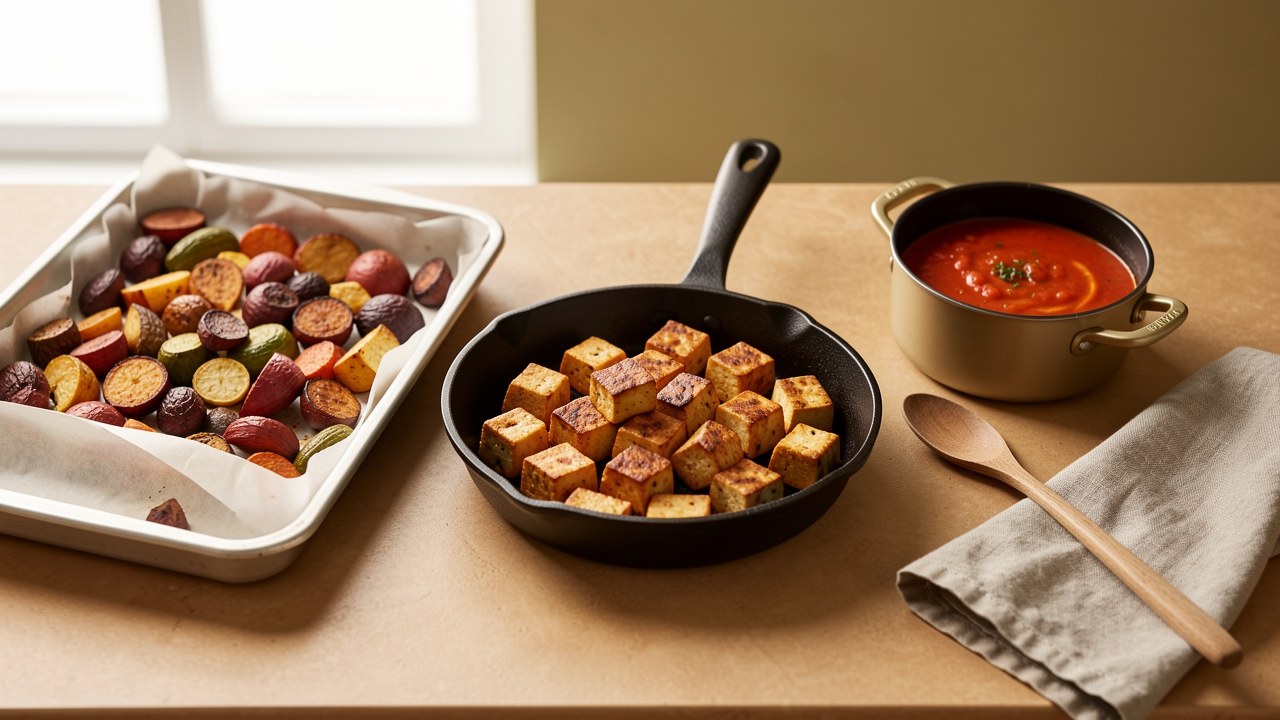
Sheet-pan cooking follows the same logic at scale. A rimmed shallow baking or roasting pan—most often a 13 by 18 inch sheet pan, though a jelly roll pan works too—lets you roast vegetables and a protein together. Lining the pan with parchment makes cleanup easier. Common practice puts sheet-pan meals at 425°F, roughly the temperature used for roasting vegetables, but recipes vary: one worked example combines broccolini, red onion, bell peppers, carrots, zucchini, sweet potatoes and chickpeas at 350°F for 35 to 40 minutes. That is one recipe's practice, not a single standard—follow the temperature in the recipe you are using, and use the roasting table above as your baseline when improvising.
For vegetarian proteins, the goal is usually texture. Tofu can be tossed with oil, panko and sesame seeds and baked in a high-heat oven rather than fried; roasted tofu also develops a pleasant chew. Tempeh crumbled by hand into bite-sized pieces with craggy corners becomes crispy outside and chewy inside after a few minutes of cooking. Beans roasted alongside vegetables turn crispy and add substance to the pan. Remember that browning is flavor, but burnt is not—pull pieces that are done early or move them to a cooler part of the pan.
- Middle rack; food uncovered on a baking sheet.
- Toss with oil or butter; spread out so pieces are not crowded.
- Turn every 15 to 20 minutes for even cooking.
- Soft vegetables: 375°F for 25–30 minutes (e.g., half-inch zucchini rounds).
- Hard vegetables: 400–425°F for 25–30 minutes (e.g., sweet potato wedges).
- Tofu: bake crumb-coated or torn pieces at high heat for chew and crisp edges.
- Tempeh: crumble by hand for craggy pieces that crisp outside and stay chewy inside.
- Beans: roast alongside vegetables; they become crispy.
Sources: University of Kentucky Cooperative Extension Service (FCS3-634), The Vegan Atlas, Oh My Veggies, The Monday Campaigns (Meatless Monday), Food52, Eater, Pinch of Yum
Sautéing, searing and building flavor in a skillet
Sautéing is a form of pan-frying that uses only a small amount of fat—which makes it lighter than deep-frying. The fat prevents sticking, transfers heat, and adds flavor. The best pan temperature is medium to medium-high; if the pan is too hot, the outside of the food will burn before the inside is cooked through. You will know the pan is ready when the added fat spreads and has a shimmery appearance.
Add food in a single, even layer that is not crowded, and stir or toss every so often until it develops color and reaches the desired doneness. That brownness is the point: it adds deep flavor without being burnt. When you choose an oil, consider the cooking method and temperature so you pick one with an appropriate smoke point; for very high temperatures, canola or vegetable oil is a better choice.
Skillet cooking is also where you build a sauce. Torn tofu can be pan-fried until crispy and then finished with a sticky or saucy glaze—a template you can apply to tempeh, seitan, or cooked beans. If you are new to a vegetarian protein, start with a moderate pan temperature, give the pieces room, and let them sit undisturbed long enough to release from the pan before you stir.
- Use a small amount of fat, not a deep fry.
- Medium to medium-high heat; avoid a pan that is too hot.
- Wait for the fat to shimmer before adding food.
- Single, even, uncrowded layer; stir or toss occasionally.
- Doneness cue: good color and the texture you want.
- Choose an oil suited to the temperature—canola or vegetable for very high heat.
- Finish pan-fried tofu, tempeh or beans with a glaze for a quick main.
Sources: University of Kentucky Cooperative Extension Service (FCS3-634), Pinch of Yum
Simmering, stewing and soup foundations
Simmering and stewing are moist-heat methods that turn firm vegetables, beans and grains into a cohesive dinner. Braising—the slow, covered cook that produces a stew—combines cooking methods: it uses both dry and moist heat, and it can include searing and sautéing before the liquid goes in. That step is where much of the flavor is built, so if you have ten extra minutes, brown your aromatics and your protein first.
For a weeknight soup or stew, the practical move is to build in layers: sauté aromatics until they soften and smell sweet, add ground spices and let them bloom in the fat for a moment, then add liquid and your main ingredients and bring to a gentle simmer. Keep the heat low enough that the surface moves but does not boil hard—this keeps vegetables from breaking apart and lets flavors marry.
Because simmering is gentle, it is the right method for sturdy greens, root vegetables, dried or canned beans, lentils and grains. It is less suited to tender vegetables you want crisp. If you are adapting a recipe, add quick-cooking ingredients near the end so they do not turn to mush. Serve soups and stews with a starch—rice, noodles, crusty bread, or a scoop of grains—to make them a complete dinner.
- Braise and stew use both dry and moist heat, often starting with a sear or sauté.
- Sauté aromatics first; bloom spices in the fat before adding liquid.
- Keep the pot at a gentle simmer, not a rolling boil.
- Best for sturdy vegetables, beans, lentils and grains.
- Add tender or quick-cooking vegetables near the end.
- Finish with acid, herbs or a drizzle of oil to brighten the bowl.
Sources: University of Kentucky Cooperative Extension Service (FCS3-634)
Steaming and blanching for texture
Steaming is the recommended cooking method for cruciferous vegetables such as broccoli, cauliflower, cabbage, Brussels sprouts and radishes. The procedure is simple: put a half-inch of water in the bottom of a saucepan, bring it to a boil, add the vegetables, cover, and let them steam for approximately five minutes, or until they reach the tenderness you prefer. Less cooking time leaves more nutrients in the vegetables, and overcooking cruciferous vegetables produces a strong odor and makes them less appetizing.
Steaming is not just a side-dish method. Steam sturdy greens or broccoli until crisp-tender, then toss them with a sauce, a dressing, or a skillet of sautéed aromatics and beans to make a main. Because steamed vegetables hold their shape and color, they also work well as a component in grain bowls, tacos, and noodle dishes where you want contrast against a soft or saucy element.
Blanching—briefly boiling then plunging into ice water—is a related technique for par-cooking vegetables before a final sear or grill. It sets color and texture and shortens the time a vegetable spends in a hot pan. The general principle is the same as steaming: cook just until the texture is right, then stop the cooking.
- Half-inch of water in the pan, bring to a boil, add vegetables, cover.
- Steam approximately 5 minutes, or to preferred tenderness.
- Less cooking time preserves more nutrients.
- Overcooking cruciferous vegetables produces a strong odor.
- Steam, then sauce or toss with beans for a quick main.
- Blanch to par-cook before searing or grilling.
Sources: University of Kentucky Cooperative Extension Service (FCS3-566)
Grilling and broiling vegetarian mains
Grilling and broiling are high, direct-heat methods that give vegetarian mains a browned crust and a smoky note. They are less forgiving than roasting because the heat is intense and the window between browned and burnt is short. The practical approach is to start with ingredients that hold their shape—thick slices of eggplant or zucchini, portobello caps, firm tofu pressed and cut into slabs, tempeh, or skewers of vegetables and halloumi—and to oil both the food and the grill grate or broiler pan.
Broiling is essentially an upside-down grill inside your oven. It is excellent for blistered vegetables and for finishing a dish with color. Cherry tomatoes, for example, can be broiled until their skins char and blister and they collapse into a jammy sauce—useful as a quick pasta or grain-bowl topping. Tomato halves can also be broiled until tender and lightly browned on top.
Because broiler settings and rack positions differ by oven, use visual cues rather than a single time: set the rack so the food is a few inches from the element, watch it continuously, and turn pieces as they brown. If you are grilling, set up a two-zone fire—one side hot, one side cooler—so you can move pieces that are coloring too fast. Serve grilled or broiled mains with a sauce, a squeeze of lemon, or a herb oil to keep them from tasting dry.
- Use firm, thick-cut vegetables, pressed tofu, tempeh or skewers.
- Oil the food and the grate or broiler pan.
- Broil cherry tomatoes until charred and jammy.
- Tomato halves broil until tender and lightly browned.
- Watch continuously—broilers vary by oven.
- Use a two-zone grill to manage flare-ups and fast browning.
- Finish with sauce, citrus or herb oil.
Sources: University of Kentucky Cooperative Extension Service, Eater
Matching method to ingredient and time available
The fastest way to improve a weeknight vegetarian dinner is to stop asking “what should I cook?” and start asking “what method fits the time and the ingredient I have?” Roasting and sheet-pan cooking are hands-off but take 25 to 40 minutes of oven time; sautéing and skillet cooking are fast and interactive; simmering and stewing are slow but largely unattended; steaming is quick and preserves texture; grilling and broiling are fast but need your attention.
Use the ingredient as your second filter. Hard vegetables such as sweet potatoes, winter squash, carrots and beets thrive under high, dry heat. Soft vegetables such as zucchini, tomatoes and peppers cook faster and can go either in the oven or in a skillet. Cruciferous vegetables are at their best steamed and then dressed. Tofu and tempeh can be roasted for chew or pan-fried for crisp edges—choose based on whether you want to be at the stove.
Time brackets are a useful organizing principle: many vegetarian recipe collections sort recipes into a quick weeknight category of roughly 20 to 30 minutes, and sheet-pan cooking is often described as requiring roughly 20 to 30 minutes of cook time. If you have less than half an hour and want to be mostly hands-off, choose a skillet method with pre-cut vegetables, or steam a vegetable and toss it with a pantry sauce and a can of beans. If you have 40 minutes and want to do almost nothing, roast a pan of hard vegetables and a protein together.
- Under 30 minutes and hands-on: sauté, pan-fry or steam.
- Around 20 to 30 minutes, mostly hands-off: sheet-pan roast.
- 40 minutes and hands-off: roast hard vegetables plus a protein.
- All evening, mostly unattended: simmer a soup or stew.
- Fast and attention-heavy: grill or broil.
- Hard vegetables: high, dry heat. Soft vegetables: faster, either way.
- Cruciferous vegetables: steam, then sauce.
- Tofu and tempeh: roast for chew, pan-fry for crisp edges.
Sources: University of Kentucky Cooperative Extension Service (FCS3-634), University of Kentucky Cooperative Extension Service (FCS3-566), The Monday Campaigns (Meatless Monday), 101 Cookbooks (Heidi Swanson)
Side-by-side category and decision-criteria matrix
The table below compares three core vegetarian cooking methods across the criteria that most affect a weeknight decision: the type of heat, temperature guidance, time guidance, the flavor mechanism, how to handle the food, and the doneness cue. The comparison is by method category and decision criteria—not a ranking of specific recipes—because the reliable, comparable attributes are attached to methods rather than to named dishes. Use it to narrow your choice, then follow a tested recipe for exact quantities and times.
| Method | Heat type | Temperature guidance | Time guidance | Flavor mechanism | Handling note | Doneness cue |
|---|---|---|---|---|---|---|
| Roasting (oven and sheet pan) | Dry, indirect oven heat | 375°F for soft vegetables such as half-inch zucchini rounds; 400–425°F for hard vegetables such as sweet potato wedges | 25–30 minutes for the vegetables in the reference table | Maillard reaction produces a sweet, caramelized taste and toasty brown color | Toss with oil or butter, spread evenly on a baking sheet, and turn every 15–20 minutes | Vegetables softened with good color |
| Sautéing and pan-frying | Stovetop pan with a small amount of fat | Medium to medium-high heat; too hot burns the outside before the inside cooks | Not specified in the reference guidance | Developed brownness adds deep flavor without burning | Wait for the fat to spread and shimmer; add food in a single, even, uncrowded layer and stir or toss occasionally | Food develops color and reaches the desired doneness |
| Steaming and simmering (moist-heat basics) | Moist heat from boiling water turned to steam under a cover | Not specified in the reference guidance; the method uses a half-inch of boiling water | Approximately 5 minutes for cruciferous vegetables, or until the preferred tenderness is reached | Not specified in the reference guidance; the source notes that less cooking time retains more nutrients and that overcooking produces a strong odor | Half-inch of water in the pan bottom, bring to a boil, add vegetables, cover | Preferred tenderness reached; do not overcook |
Sources: University of Kentucky Cooperative Extension Service (FCS3-634), University of Kentucky Cooperative Extension Service (FCS3-566)
Frequently asked questions
How do I get crispy roasted vegetables for dinner?
Start with dry vegetables, toss them with oil or butter, and spread them in a single layer on a baking sheet with a little space between pieces. Use the middle rack and turn them every 15 to 20 minutes so they cook evenly. For soft vegetables such as zucchini rounds, roast at 375°F for 25 to 30 minutes; for hard vegetables such as sweet potato wedges, use 400°F to 425°F for 25 to 30 minutes. They are done when they are softened and have good color. Crowding the pan steams the vegetables instead of browning them, so use two pans if you need to.
Sources: University of Kentucky Cooperative Extension Service (FCS3-634)What is the best way to cook tofu for beginners?
Two approaches are forgiving. To bake, toss tofu with oil, panko and sesame seeds and bake it in a high-heat oven rather than frying—this gives a crisp coating without a pot of oil. To pan-fry, tear or cube the tofu, heat a small amount of oil over medium to medium-high heat until it shimmers, add the tofu in a single uncrowded layer, and cook until the pieces are crispy, then finish with a sticky or saucy glaze. Pressing the tofu first helps it release water so it browns rather than steams.
Sources: University of Kentucky Cooperative Extension Service (FCS3-634), Food52, Pinch of YumCan I use the same method for any vegetarian protein?
Not exactly—each protein behaves differently. Tofu can be baked crumb-coated for a crisp shell or pan-fried until crispy, and it also develops a pleasant chew when roasted. Tempeh is best crumbled by hand into bite-sized pieces with craggy corners, then cooked for a few minutes so the outside crisps and the inside stays chewy. Beans become crispy when roasted alongside vegetables. All three work in a skillet or in the oven, but the timing, oil amount and desired texture differ, so match the method to the result you want rather than using one method for everything.
Sources: The Monday Campaigns (Meatless Monday), Food52, Eater, Pinch of YumHow do I keep vegetarian dinners from tasting bland?
Build flavor in stages. Browning is the most reliable tool: the brownness food develops during sautéing adds deep flavor without being burnt, and the Maillard reaction during roasting gives a sweet, caramelized taste and toasty brown color. So give vegetables and proteins room in the pan and let them color. Then layer in aromatics, bloom ground spices in the fat, add acid at the end with lemon or vinegar, and finish with fresh herbs or a drizzle of good oil. Steaming is the exception—it preserves texture, so sauce the vegetables after cooking rather than trying to brown them.
Sources: University of Kentucky Cooperative Extension Service (FCS3-634), University of Kentucky Cooperative Extension Service (FCS3-566)Sources
- Savor the Flavor: Exploring Cooking Methods — University of Kentucky Cooperative Extension Service (FCS3-634)
- FSHE-10A: Vegetables for Wellness: Kentucky Tomatoes — University of Kentucky Cooperative Extension Service
- The Health Benefits of Cruciferous Vegetables — University of Kentucky Cooperative Extension Service (FCS3-566)
- 19 Tasty, Easy Vegan Sheet Pan Dinners — The Vegan Atlas
- Sheet Pan Meal With Vegetables And Chickpeas (Vegan) - Oh My Veggies — Oh My Veggies
- 10 Sheet Pan Recipes for Easy Plant-Based Dinners - Meatless Monday — The Monday Campaigns (Meatless Monday)
- 50+ Vegetarian Dinner Recipes — 101 Cookbooks (Heidi Swanson)
- Our Most Popular Vegetarian Recipes of All Time - Food52 — Food52
- These Are the Best Vegetarian Dinner Recipes, According to Eater Editors | Eater — Eater
- 45 Actually Delicious Vegetarian Dinner Recipes - Pinch of Yum — Pinch of Yum