How to plan vegetarian dinners for a week
Weekly vegetarian meal prep works best when you plan dinners as mix-and-match components rather than seven finished plates. Cook-ahead blogs describe the same core idea: you prepare a handful of building blocks over the weekend, then combine them differently each night. Many home cooks build each dinner from a simple formula—a protein, a grain, a vegetable, a fat or sauce, and a flavor booster—so the same three or four prepped items can become a bowl, a pita, a salad or a soup.
Start by choosing four to six components rather than a full menu. For example: one cooked grain, one cooked bean or legume, one roasted vegetable, one raw or quick-pickled vegetable, one sauce, and one prepped protein such as tofu or tempeh. That set covers roughly four to five dinners when you vary the sauce, the bread or the greens, and it keeps you from cooking the same meal all week.
Then decide which nights get a hot dinner and which get a cold or assembled one. A typical week might use Monday for a grain bowl, Tuesday for soup with toast, Wednesday for tacos or pita pockets, Thursday for a roasted-vegetable pasta, and Friday for leftovers turned into a salad. You are not committing to specific recipes yet—you are committing to shapes of meals, which makes the actual cooking faster.
- Choose 4–6 components: one grain, one bean or legume, one roasted vegetable, one fresh or pickled vegetable, one sauce, one prepped protein.
- Assign each night a meal shape: bowl, soup, taco, pasta, salad.
- Build a shopping list around the components, not around individual recipes.
- Write the prep order on a note: longest-cooking items first, quick items while the oven is on.
- Leave one night open for takeout or leftovers to absorb the unexpected.
Sources: The Kitchn, The New Baguette, Cozy Peach Kitchen
Choosing recipes that reheat
Some vegetarian dinners reheat beautifully and some are better the day they are made. The practical distinction is between sturdy, moisture-rich dishes and delicate ones. Soups, stews, chili, curries, baked pasta, roasted root vegetables and braised or baked tofu tend to hold up over several days. Salads with tender greens, crispy fried items, and anything that relies on a crisp crust are better assembled fresh.
Blog guidance points in the same direction: hearty items such as bean chili, lentil soup and roasted root vegetables are described as lasting the full storage window, while lighter salads with fresh greens are best within a shorter one. Treat this as practical pattern rather than a tested result—the same dish can behave differently depending on how wet it is, how it was cooled, and how it was packed.
When you are choosing recipes for a prep day, favor ones that share equipment and temperature. If two dishes both roast at 425°F, cook them together. The Kitchn's week-long vegetarian plan, for instance, preps stir-fry components, a farro salad, muesli, hard-boiled eggs, tofu, roasted vegetables, pickled onions and sauces, then draws on them across the week for stir-fry, pita pockets, kale salad and shakshuka. The point is not that those specific dishes are required, but that they share prep steps and recombine easily.
One caution that applies to every batch: cool cooked components slightly before you portion them out. This is standard prepping advice and keeps steam from turning containers into a puddle.
- Prefer soups, stews, curries, chili, baked pasta and roasted vegetables for multi-day storage.
- Hold back delicate greens, crispy coatings and anything meant to stay crunchy; add them the day you eat.
- Group recipes by cooking temperature and equipment so one oven session does the work.
- Cool cooked food slightly before sealing it in containers.
Sources: The Kitchn, Sweet Peas and Saffron, Louisville Jerky Co.
Batch-cooking grains, beans and roasted vegetables
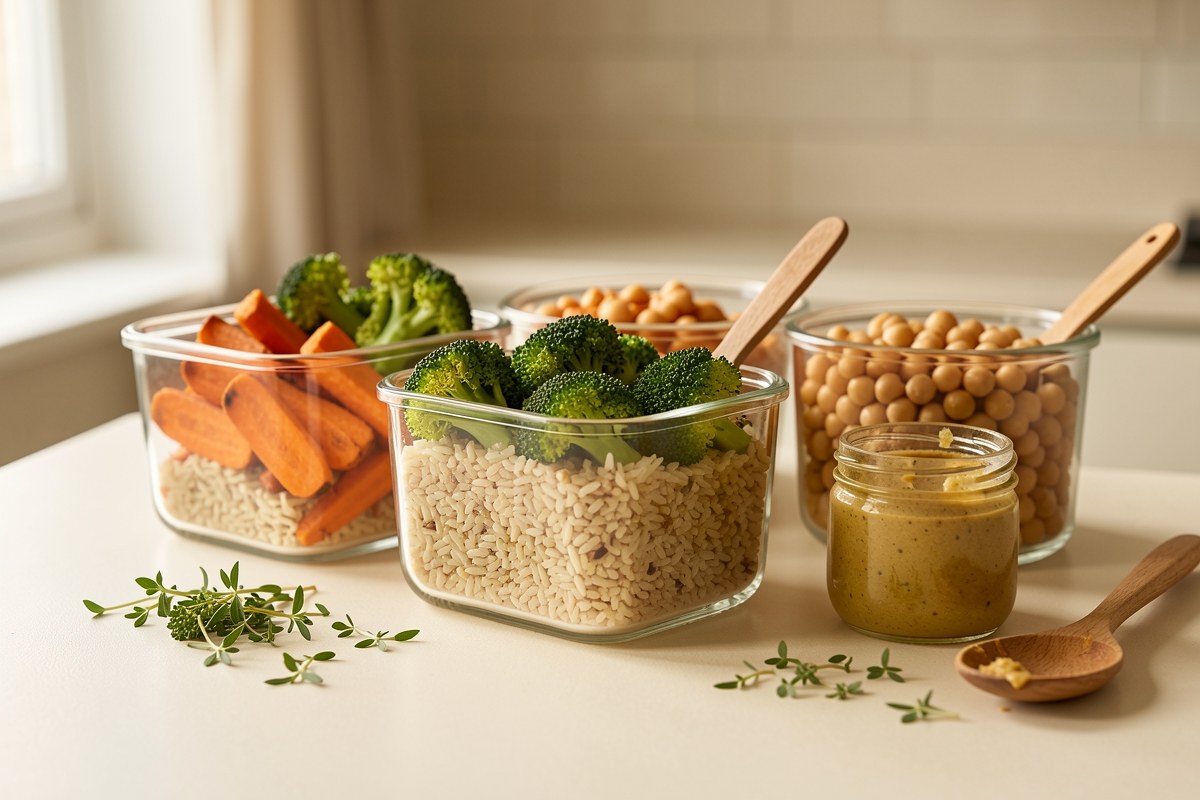
The three workhorses of vegetarian meal prep are a cooked grain, a cooked bean or legume, and a tray of roasted vegetables. Together they form the base of bowls, the filler for wraps, the body of soups and the topping for salads. Cooking them in one block of time turns a week of dinners into a series of assemblies.
Grains are the simplest. Cook rice, farro, quinoa or pasta according to package directions, then spread them on a sheet pan or a wide bowl to cool before storing. One food blog that focuses on meal prep roasts sweet potato whole or in half-inch cubes and roasts vegetables for 15–25 minutes at 425°F until al dente. Those figures describe one author's method rather than a universal rule; the useful habit is to roast at a high temperature and pull the tray while the vegetables still have a little bite so they survive reheating.
For beans and legumes, the choice is between cooking dried beans from scratch and using canned. Canned beans are already cooked; draining and rinsing them is enough. Dried beans need a longer simmer, so they belong at the start of a prep session. Either way, cook a larger batch than you need for one meal—beans freeze well in their cooking liquid or with a little oil, and they thaw into soups and bowls without much fuss.
While the oven and the stove are working, use the waiting time for quick jobs: washing and drying greens, mixing a sauce, or making a grain salad. The Kitchn's plan completes its full week of vegetarian prep in just under two hours, which is a reasonable target if you organize the session around passive cooking time rather than standing at the stove.
- Start the longest item first: dried beans, a pot of grains, or a soup base.
- Preheat the oven and cut vegetables for roasting while the grains cook.
- Roast the vegetables at 425°F for 15–25 minutes, checking for doneness and pulling them while slightly firm.
- Cook tofu, tempeh or another protein in the same oven or on the stovetop.
- Mix one or two sauces while the oven is on.
- Cool everything slightly, then portion into containers.
Sources: The Kitchn, Sweet Peas and Saffron, Cozy Peach Kitchen
Storage containers, labels and fridge life
Container choice affects how easily you use what you prepped. For individual portions, a two-compartment bento box keeps wet and dry components separate. For larger amounts of a single component—a pot of grains, a batch of soup—a six-cup container is a useful size. The goal is to see what you have at a glance, so you actually eat it.
Labeling is a habit worth building even though no single authority prescribes a specific system. A strip of tape with the contents and the date is enough. It tells you what is in an opaque container and lets you use the oldest items first. Keep a marker near the containers so labeling takes seconds rather than becoming a chore.
On fridge life, the available guidance comes from food blogs and should be read as practical ranges, not as safety limits. One meal-prep blog states that sauces portioned into small containers and cooked vegan lunch and dinner recipes can be stored in the refrigerator for up to four days. A brand guide describes most cooked vegan meals as lasting three to five days in a sealed, airtight container, with hearty items such as bean chili, lentil soup and roasted root vegetables at the longer end and lighter salads closer to three days. Washing and drying leafy greens, rolling them in paper towel and storing them in a bag is described as keeping greens fresh for about a week.
For anything beyond a few days, freezing is the more reliable route. Soups, stews, curries and bean burgers are described as freezing well, and portioning them into single servings before freezing makes them easy to reheat later. Cool the food before freezing, leave a little headroom in the container for expansion, and thaw in the refrigerator overnight when you can.
| Component | Stated refrigerator range | Source type |
|---|---|---|
| Cooked vegan lunches and dinners | Up to 4 days | Meal-prep blog |
| Sauces portioned into small containers | Up to 4 days | Meal-prep blog |
| Most cooked vegan meals (general) | 3–5 days | Brand guide |
| Hearty chili, lentil soup, roasted root vegetables | Toward the 5-day end | Brand guide |
| Salads with fresh greens | Best within 3 days | Brand guide |
| Washed and dried leafy greens | About 1 week | Dietitian-authored blog |
Sources: Sweet Peas and Saffron, Delish Knowledge, Louisville Jerky Co.
A sample vegetarian dinner prep day
A prep day does not have to be a full day. The aim is one focused block of time that leaves you with components for several dinners. The sequence below is a sample built from the component approach; adjust the quantities to your household and swap in the vegetables, grains and proteins you actually like.
Begin with a short list and a clear order. Long-cooking items go on first. While they simmer, the oven handles the vegetables and any protein that roasts. The last stretch is for sauces, greens and packing.
The Kitchn's week-long vegetarian plan follows this shape: it preps stir-fry components, a farro salad, muesli, hard-boiled eggs, tofu, roasted vegetables, pickled onions and sauces, then combines them across the week into stir-fry, pita pockets, kale salad and shakshuka. You do not need to copy that exact list; the lesson is that a handful of components can become several different dinners.
- Put a pot of grains on the stove and, if you are using dried beans, start them simmering.
- Heat the oven to 425°F and cut a tray of vegetables—broccoli, cauliflower, carrots, peppers or sweet potato.
- Roast the vegetables for 15–25 minutes, checking for doneness and leaving a little bite.
- While the oven runs, press and cube tofu or tempeh, or drain and rinse canned beans.
- Cook the protein in the oven or a skillet alongside the vegetables.
- Mix one or two sauces: a tahini dressing, a balsamic vinaigrette or a simple tomato sauce.
- Wash and dry greens, then store them in a paper-towel-lined bag.
- Cool everything slightly, portion into containers, and label with contents and date.
Sources: The Kitchn, Sweet Peas and Saffron, Delish Knowledge
Adapting prep for one or two people
Cooking for one or two changes the math of a prep day. A full tray of roasted vegetables and a large pot of grains can be more than you will finish before it loses quality, so the practical move is to prep smaller batches more often, or to freeze half of each batch immediately.
A workable approach is to prep two or three components instead of five or six, then add quick fresh elements—a handful of greens, a fried egg, a piece of toast—on the night you eat. A single grain, a single bean and a single roasted vegetable can still make bowls, tacos, soups and salads across three or four dinners when you vary the sauce and the finishing touch.
Freezing is your friend in a small household. Portion soups, stews and bean dishes into single servings before they go into the refrigerator, and move one serving to the fridge the night before you plan to eat it. That way a batch that would otherwise sit for a week becomes several meals spread over a month.
Finally, keep the container sizes small. Two-compartment bento boxes work well for single portions, and a few six-cup containers are enough for batch components. You can build your own simple prep sheet by listing the components you have, the day you cooked them, and which dinner shape each one fits—no special template required.
- Prep two or three components, not five or six.
- Freeze half of any large batch in single servings.
- Move one frozen serving to the fridge the night before you plan to eat it.
- Keep a short list of dinner shapes—bowl, taco, soup, salad—so you can improvise.
- Use small containers for single portions and a few larger ones for batch components.
Sources: The New Baguette, Louisville Jerky Co.
Frequently asked questions
How far ahead can I prep vegetarian dinners?
The practical ranges that appear in food blogs are three to five days for most cooked vegan meals in a sealed container in the refrigerator, with up to four days for cooked lunches and dinners and for sauces portioned into small containers. Hearty dishes such as chili, lentil soup and roasted root vegetables are described as lasting toward the longer end, while salads with fresh greens are best within about three days. Washed and dried leafy greens stored in paper towel in a bag are described as keeping for about a week. These are blog-stated ranges, not a safety standard; use your own judgment and freeze anything you will not finish within a few days.
Sources: Sweet Peas and Saffron, Delish Knowledge, Louisville Jerky Co.Which vegetarian dinner components do not reheat well?
Delicate items are the ones to hold back: salads with tender greens, anything with a crisp coating or crust, and components meant to stay crunchy. Hearty dishes—soups, stews, curries, chili, baked pasta and roasted root vegetables—generally reheat better. This is a practical pattern from prepping guides rather than a tested result, so expect some variation depending on how wet the dish is and how it was packed and cooled.
Sources: The New Baguette, Louisville Jerky Co.Can I meal prep vegetarian dinners for a family?
Yes. The component approach scales naturally: cook a larger pot of grains, a larger tray of roasted vegetables and a bigger batch of beans or tofu, then let each person combine them differently. Family prepping also benefits from choosing recipes that share an oven temperature so one session covers several dishes. The same storage ranges apply—plan to eat the lighter items first and freeze what you will not finish within a few days.
Sources: The Kitchn, Louisville Jerky Co., Cozy Peach KitchenHow do I keep prepped vegetables from getting soggy?
Roast at a high temperature—one meal-prep blog uses 425°F for 15–25 minutes—and pull the tray while the vegetables still have a little bite, since softer vegetables release more water as they sit. Store roasted vegetables in a container that is not sealed while they are still steaming, or let them cool slightly first. For raw greens, wash and dry them thoroughly, roll them in paper towel and store them in a bag; that method is described as keeping greens fresh for about a week.
Sources: Sweet Peas and Saffron, Delish KnowledgeWhat should I prep first on a meal-prep day?
Start the longest-cooking item first—dried beans, a pot of grains or a soup base. While that simmers, heat the oven and cut vegetables for roasting. When the oven is on, roast the vegetables and any protein that cooks at the same temperature. Use the waiting time for sauces, washing greens and packing containers. This order keeps you from standing at the stove and lets passive cooking do most of the work.
Sources: The Kitchn, Sweet Peas and SaffronDo I need special containers for vegetarian meal prep?
No special containers are required, but a few sizes help. One meal-prep blog recommends two-compartment bento boxes for individual portions and six-cup containers for larger batches of a single component. The useful principles are to keep wet and dry items separate when you can, use containers you can see through or label clearly, and leave a little headroom if you plan to freeze.
Sources: Sweet Peas and SaffronHow do I label prepped containers?
A strip of tape with the contents and the date is enough. Labels matter most for opaque containers and for frozen portions, where you cannot see what is inside. Keeping a marker near the containers makes labeling a two-second habit instead of a chore. No single source in the available guidance prescribes a specific labeling system; the goal is simply to know what you have and to use the oldest items first.
Sources: Sweet Peas and SaffronSources
- Meal Prep Plan: A Week of Easy Vegetarian Meals — The Kitchn
- 60 Vegan Meal Prep Ideas for Breakfast, Lunch and Dinner — Sweet Peas and Saffron
- 50 Easy Vegan Meal Prep Recipes — Delish Knowledge
- 20+ Plant-Based Meal Prep Ideas - The New Baguette — The New Baguette
- Your Guide on How to Meal Prep for Plant-Based Beginners — Louisville Jerky Co.
- 30 Vegetarian Pantry Staple Recipes — Cozy Peach Kitchen