How to cook vegetarian dinners faster
Speed in a vegetarian kitchen rarely comes from a single trick. It comes from deciding which parts of the meal you are willing to buy pre-cut, pre-cooked, or already sauced, and which parts you want to cook from scratch because that is where the flavor lives. A quick vegetarian dinner is usually a starch, a protein, a vegetable, and a sauce, and the fastest versions of that formula lean on at least one component that is already done before you turn on the stove.
A useful way to plan is to think in cooking windows rather than in cuisines. Decide how many minutes you truly have, then choose a dish whose active work fits that window. Many vegetarian recipe writers organize their fast collections the same way: Easy Cheesy Vegetarian groups its quick dinners by short total times, with examples listed at total times such as 10 minutes, 15 minutes and 20 minutes. That is a good mental model even if you never open a recipe, because it forces the time decision before the cooking decision.
- Choose your time band first, then your dish, so you do not start a 30-minute meal at 6:45 on a night you need to eat by 7.
- Keep a fast starch on hand, such as noodles, quick-cooking grains, or tortillas, so the base of dinner is never the bottleneck.
- Use one bag of mixed stir-fry vegetables instead of buying and cutting several vegetables when time is the priority; Easy Cheesy Vegetarian recommends exactly this shortcut.
- Cook a double batch when you do have time, so the next night's dinner is largely reheating; Easy Cheesy Vegetarian lists batch cooking and leftover freezing as a time-saving habit.
Sources: Easy Cheesy Vegetarian
15-minute dinners for the shortest nights
Fifteen minutes is enough for a real dinner if the water is already boiling or the pan is already hot. Recipes in this band tend to be noodle, pasta, or bean dishes where the sauce comes together while the base cooks, or where a canned or pre-cooked ingredient carries most of the meal.
Easy Cheesy Vegetarian lists several vegetarian dinners with short total times in this range, including peanut and sesame noodles, creamy pasta primavera, creamy white beans with goat cheese, creamy chickpea curry, vegan cream of mushroom soup, halloumi piccata, veggie chow mein and mushroom stroganoff. For the very shortest window, the same collection lists a 10-minute air fryer quesadilla, which is a useful fallback when you want something hot with almost no stovetop work.
- Peanut and sesame noodles: boil noodles, whisk a sauce, toss with whatever crunchy vegetables you have.
- Creamy white beans with goat cheese: a canned-bean dish that thickens into a sauce as it warms.
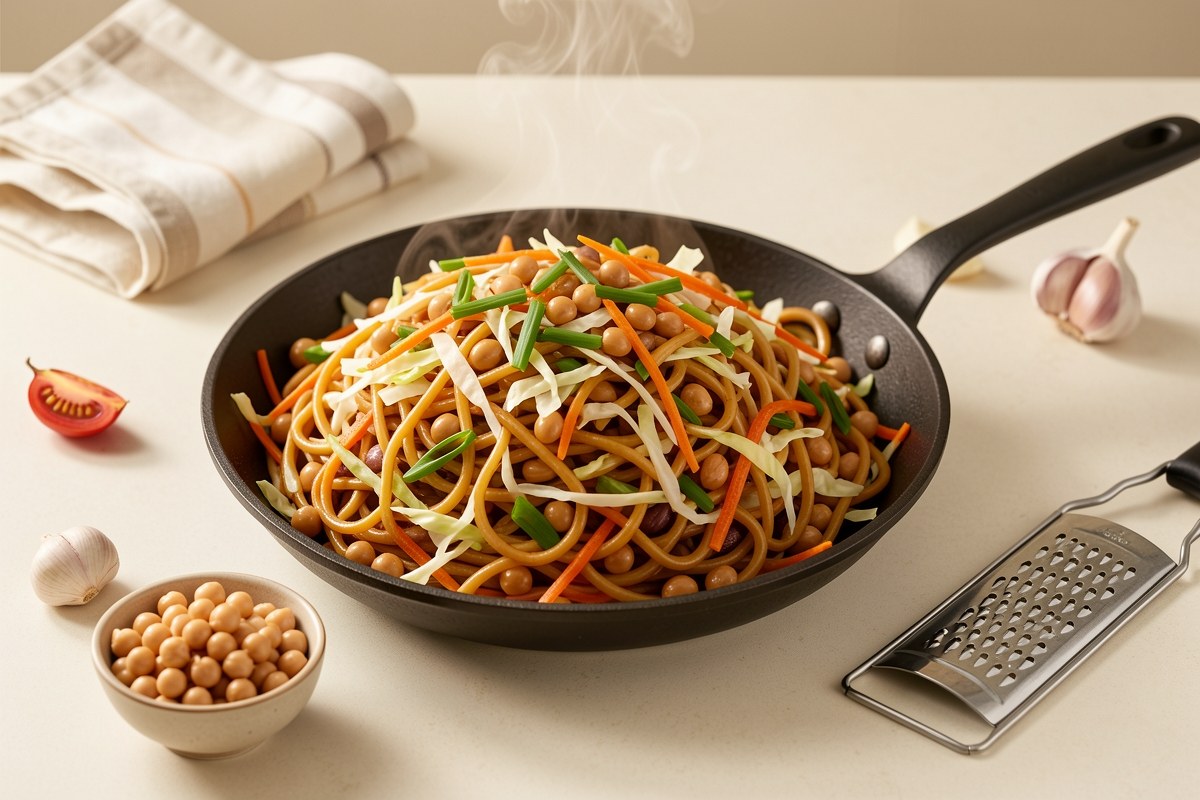
- Veggie chow mein: built for a bag of mixed stir-fry vegetables.
- Creamy chickpea curry: pantry protein plus a sauce, served over rice or with bread.
- Mushroom stroganoff or creamy pasta primavera: pasta-based dinners where the sauce is the quick part.
- Air fryer quesadilla: the 10-minute option when you do not want to watch a pot.
Sources: Easy Cheesy Vegetarian
30-minute dinners and easy weeknight vegetarian recipes
Thirty minutes is the most forgiving band. It gives you time to roast a tray of vegetables, simmer a short sauce, or build a skillet dinner, and it is long enough for dishes that need a few minutes of real browning before the liquid goes in. This is also the band where easy weeknight vegetarian recipes stop feeling like compromises, because you can cook an onion properly and still sit down on time.
The clearest way to use this band is to steal named dishes from published collections rather than inventing a plan at 6 p.m. Food52's collection states that each listed vegetarian dinner takes 30 minutes or less start to finish and names specific dishes, which makes it a practical shopping and cooking list rather than just inspiration.
- One-pan Tuscan ravioli: a single skillet, a short sauce, and no separate pot of boiling water to manage.
- Quick Italian veggie skillet: vegetables and aromatics cooked together with a fast finish.
- Easy chana masala: chickpeas and a spiced tomato base, served with rice or bread.
- Cauliflower and tofu curry: a 30-minute curry built on a firm protein and a quick sauce.
- Peanut butter noodles: a noodle base with a pantry sauce that comes together while the water boils.
- Tomato and garlic butter bean dinner: a canned-bean skillet that thickens into its own sauce.
- Spinach pizza quesadillas: a tortilla-based dinner for nights when even a pot feels like too much.
- Vegetarian pad thai: a noodle stir-fry where the sauce is whisked in advance and the cooking is fast.
Sources: Food52, Taste of Home
Shortcut ingredients worth keeping on hand
Shortcuts are not cheating; they are how a fast dinner stays fast when the day runs long. The most useful ones remove chopping, soaking, or a long simmer, and they should be things you actually like eating, because a shortcut you do not enjoy just moves the problem.
The clearest supported example is a bag of mixed stir-fry vegetables: Easy Cheesy Vegetarian suggests using one to save prep time and avoid buying each vegetable individually, in the context of dishes like red Thai curry noodle soup and veggie chow mein. A second supported pattern is pantry-centered cooking: The Plant Based School states that its 30-minute dinners are built from pantry staples such as beans, lentils, pasta, and a few fresh vegetables, and that they do not require endless chopping or fancy ingredients. Taste of Home likewise frames its collection as including both fresh-vegetable dishes and pantry-friendly meals for when ingredients are more limited.
- Pre-cut or mixed vegetables, which remove the chopping step entirely.
- Canned or pre-cooked beans and lentils, which skip soaking and a long simmer.
- Noodles, tortillas and quick-cooking grains, which keep the base of dinner fast.
- A sauce or paste you genuinely like, so flavor does not depend on a long spice-building step.
- Firm tofu or tempeh, a protein that can be cooked in one pan without a long marinade.
- Premade pizza dough, which Hello Little Home notes keeps recipes such as Caprese pizza and four-cheese spinach calzones quick.
Sources: Easy Cheesy Vegetarian, Taste of Home, Hello Little Home, The Plant Based School
One-pan and no-pot options
One-pan and no-pot dinners cut the part of cooking that people most often underestimate: the cleanup that makes a fast meal feel slow. These dishes also tend to be forgiving, because everything goes into one vessel and the timing is less precise. Published sheet-pan methods show how the approach actually works in practice, including the small decisions that determine whether the result is crisp or soggy.
The main technical point from the sheet-pan recipes is spacing and staging. Full of Plants states that keeping vegetables from touching the tofu on the baking sheet is essential for crispy tofu, that an overcrowded sheet releases moisture and makes vegetables soggy, and that vegetables should be diced evenly at about 1 inch for even cooking. Budget Bytes adds a texture tip: coating tofu cubes with cornstarch before roasting helps them crisp up, and the recipe says not to skip it. If you are adding a quick-cooking vegetable such as asparagus, Kitchen Treaty's method roasts at 425 degrees Fahrenheit and adds the asparagus about halfway through so it does not overcook. From My Bowl takes a slightly different approach, baking at 420 degrees Fahrenheit for 20 minutes, then flipping the tofu and tossing the vegetables, then baking another 20 to 25 minutes until the tofu is crispy. Either method works; the shared idea is to check and turn the pan partway through.
Expect a one-pan dinner to take longer in the oven than a stovetop dish, even though your active time is short. Kitchen Treaty's tofu and veggie sheet pan lists a total time of 45 minutes, with 15 minutes prep and 30 minutes cook, and describes most of that as hands-off. Full of Plants states its sheet-pan tofu and veggie recipe can be on the table in about 30 minutes with roughly 10 minutes of prep, and notes its tofu does not need to be pressed for that recipe. Sources differ on pressing: Budget Bytes and Kitchen Treaty recommend pressing tofu, while Full of Plants says it is not needed for its sheet-pan method. If you do press, Budget Bytes suggests weighting it with a sheet pan, books or a heavy cutting board for at least 10 minutes so it absorbs more flavor.
- Sheet-pan dinners: vegetables and a firm protein on one tray, added in the order that suits their cooking times.
- Skillet dinners: a sauce built in the same pan the base cooks in, so nothing is poured off.
- Air fryer dinners: the fastest route to a hot quesadilla or crisp vegetable when the stove is busy.
- No-pot meals: wraps, loaded toast and cold noodle bowls for nights when even one pan feels like too much.
- Serve a sheet-pan dinner over rice, with warm pita bread, or in a wrap to make it a fuller meal, as From My Bowl suggests.
Sources: Kitchen Treaty, Budget Bytes, Full of Plants, From My Bowl
Make-ahead components for fast nights
The most reliable way to make quick dinners is to move work out of the dinner hour entirely. Make-ahead components are not full meals; they are pieces you cook once and use in two or three different dinners during the week. Easy Cheesy Vegetarian recommends cooking a double batch and keeping the leftovers for the next day or freezing them for later, and preparing components in bulk, such as cooking extra baked potatoes to use in a potato bake the next day or making a double batch of pasta sauce to stir through a tomato risotto later.
The same logic applies to individual recipe components. Full of Plants states that for its sheet-pan recipe, vegetables can be diced and tossed with seasonings and refrigerated up to one day in advance, while the tofu is best tossed with cornstarch and baked the same day for the best texture. That is a useful split to remember: hardy vegetables and sauces hold up overnight, while crisped proteins are better cooked fresh. Full of Plants also notes that frozen vegetables can be used in its sheet-pan recipe, but because frozen vegetables are often pre-cooked, the baking time may need to be reduced slightly.
Treat storage and timing advice as general cooking practice rather than a rule. How long a specific component keeps depends on the food and your own kitchen practice.
- Cook one grain in a large batch and use it across two or three dinners.
- Make a double batch of pasta sauce or curry base and freeze half.
- Dice and season vegetables for a sheet-pan dinner the day before.
- Chop vegetables for the next two nights in one sitting and refrigerate them.
- Cook a double batch of a whole dish and keep the leftovers for the next day.
Sources: Easy Cheesy Vegetarian, Full of Plants
Common speed mistakes
Most slow weeknights are not caused by a difficult recipe. They are caused by starting the wrong recipe for the time available, or by discovering mid-cook that a key step was actually a long one. Reading the full method before you begin is the cheapest speed upgrade available, because it lets you move any soaking, marinating or long-simmering step to the night before.
The second common mistake is treating shortcuts as a last resort rather than a planned part of the meal. If a bag of mixed stir-fry vegetables is what makes a fifteen-minute chow mein possible, then buying it is the decision that makes dinner fast, not a compromise made at the stove. A third mistake is crowding a sheet pan. Full of Plants notes that an overcrowded pan releases moisture and makes vegetables soggy, and that keeping vegetables from touching the tofu is essential for crispy results. A fourth mistake is cooking single portions: batch cooking and freezing leftovers is one of the plainest time-saving habits in quick vegetarian collections, and it works precisely because tonight's extra ten minutes removes tomorrow's thirty.
- Reading the method only after you have started, then finding a 30-minute step.
- Choosing a dish by craving instead of by the clock.
- Doing every step in sequence when two could run at once.
- Crowding the pan so vegetables steam instead of roast.
- Cooking only as much as you need tonight, so tomorrow starts from zero again.
- Shopping for a fast recipe without checking that its shortcut ingredient is actually in the kitchen.
Sources: Easy Cheesy Vegetarian, Full of Plants
Frequently asked questions
What can I cook in 15 minutes that is vegetarian?
Fifteen-minute vegetarian dinners are usually noodle, pasta, or bean dishes, because the sauce can be made while the base cooks. Easy Cheesy Vegetarian lists peanut and sesame noodles, creamy pasta primavera, creamy white beans with goat cheese, creamy chickpea curry, vegan cream of mushroom soup, halloumi piccata, veggie chow mein and mushroom stroganoff among its short-time vegetarian dinners, and separately lists a 10-minute air fryer quesadilla for an even shorter window. Start the water or the pan first so the base is ready when the sauce is.
Sources: Easy Cheesy VegetarianWhich shortcuts keep quick vegetarian dinners flavorful?
The most useful shortcuts remove chopping or a long simmer without removing flavor. Easy Cheesy Vegetarian suggests using a bag of mixed stir-fry vegetables to save prep time instead of buying and cutting each vegetable individually, and uses that shortcut in dishes such as red Thai curry noodle soup and veggie chow mein. The Plant Based School states that its 30-minute dinners rely on pantry staples such as beans, lentils, pasta, and a few fresh vegetables, so the flavor comes from the sauce and seasoning rather than from a long ingredient list. Premade pizza dough is another supported shortcut: Hello Little Home notes it keeps recipes such as Caprese pizza and four-cheese spinach calzones quick.
Sources: Easy Cheesy Vegetarian, Hello Little Home, The Plant Based SchoolCan I prep quick dinners ahead of time?
Yes, and this is the most reliable way to make weeknights fast. Easy Cheesy Vegetarian recommends cooking a double batch and keeping the leftovers for the next day or freezing them for later, and preparing components in bulk, such as cooking extra baked potatoes to use in a potato bake the next day or making a double batch of pasta sauce to stir through a tomato risotto later. For sheet-pan dinners, Full of Plants says vegetables can be diced and tossed with seasonings and refrigerated up to one day in advance, while the tofu is best tossed with cornstarch and baked the same day for the best texture. How long a specific component keeps depends on the food and your own kitchen practice.
Sources: Easy Cheesy Vegetarian, Full of PlantsSources
- 30 Super Quick Vegetarian Dinners (20 minutes or less!) — Easy Cheesy Vegetarian
- 10 Cozy Vegetarian Dinners You Can Have on the Table in Under 30 Minutes — Food52
- 57 Vegetarian Dinners Ready in 30 Minutes or Less — Taste of Home
- 30-Minute Vegetarian Meals ... Fast, Easy + Delicious! — Hello Little Home
- Sheet Pan Tofu & Veggies — Kitchen Treaty
- Sheet Pan Cajun Tofu and Vegetables — Budget Bytes
- Crispy Tofu Veggie Sheet Pan with Thai Hummus — Full of Plants
- Sheet Pan Garlic Ranch Tofu with Vegetables — From My Bowl
- Healthy 30 Minute Recipes we Cook on Busy Nights — The Plant Based School