How much protein a dinner can realistically provide
Even without meat, a well-built vegetarian dinner can land in the range of 20 to 30 grams of protein per serving. That figure shows up repeatedly in practical nutrition writing and in meal-planning resources for meatless eaters, and it is a useful working target for many adults who want dinner to carry a solid share of the day's protein.
One reason that range is realistic: the ingredients themselves add up quickly. A cup of cooked lentils contributes roughly 18 grams of protein and 16 grams of fiber according to a registered-dietitian-authored article, while a 4-ounce serving of tempeh is listed at about 20 grams of protein. A bowl built around those foods plus a dairy or egg component can reach the low end of the range without much effort.
- A bean-only dinner may fall short: a supplied reference table lists palak paneer at about 8.5 grams per 200-gram bowl, chole at about 7.2 grams per 150-gram bowl, and rajma at about 9.4 grams per 200-gram bowl. These illustrate that a bean or dairy dish alone is not automatically a 20- to 30-gram meal.
- A tofu stir-fry is listed at about 14.5 grams per 250-gram plate in the same table, and a hummus-and-falafel plate at about 12 grams per 200-gram plate.
- Higher estimates appear in a lifestyle article: black bean enchiladas with cheese at about 25 grams, chickpea curry with Greek yogurt at about 26 grams, and three-bean chili topped with cheese served with cornbread at about 30 grams. These are illustrative estimates, not verified nutrition analyses.
- The practical lesson is that the base dish matters, but the toppers and sides often push a meal from single digits into the 20- to 30-gram range.
Sources: Fit Life Regime, Bella Vita Natural Beauty
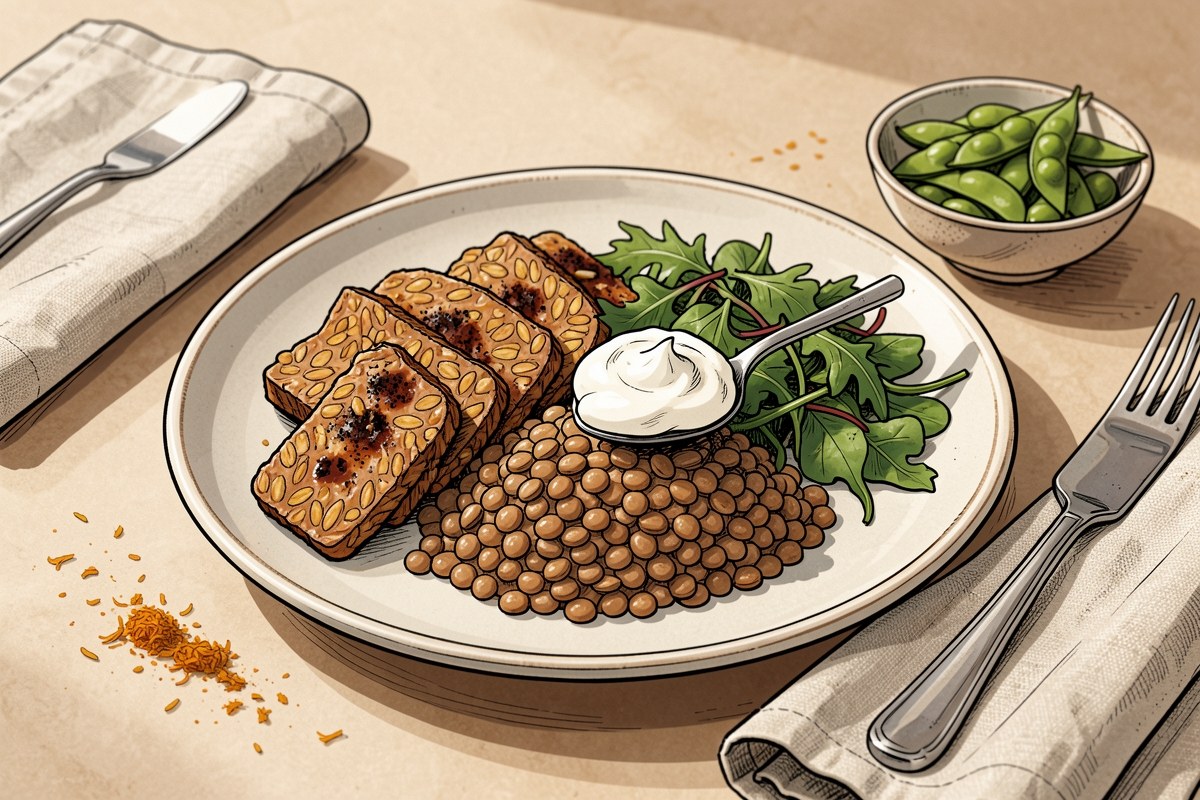
Top vegetarian protein sources for dinners
The most protein-dense vegetarian dinner ingredients tend to come from three families: soy foods, legumes, and dairy or eggs. Each has a different texture and role on the plate, so it helps to know roughly what a typical serving contributes.
Amounts below are drawn from reference tables and dietitian-authored articles. Two cautions apply. First, several sources use different bases, such as per 100 grams versus per cup, so the numbers are not directly interchangeable. Second, protein content varies by brand, fat level, and preparation, so use these as planning guides rather than exact labels.
- Soy foods such as tofu, tempeh, and edamame are among the most protein-dense vegetarian options and also appear on lists of plant proteins that supply all nine essential amino acids on their own.
- Legumes such as lentils, chickpeas, and black beans are protein-rich and high in fiber, but they are typically listed alongside grains as foods that are not complete on their own.
- Dairy and eggs round out the list. Greek yogurt, cottage cheese, cheddar, and boiled eggs all contribute meaningful protein and are often used as toppers or fillers to lift a vegetable-heavy plate.
- Seitan and wheat-based proteins are also protein-rich, though wheat is usually listed as limiting in lysine.
| Ingredient | Protein per stated serving |
|---|---|
| Firm tofu | About 17.3 g per 100 g; about 20 g per cup |
| Tempeh | About 20.3 g per 100 g; about 20 g per 4 oz, with 12 g fiber |
| Edamame | About 11.9 g per 100 g; about 17 g per cup, with 8 g fiber |
| Cooked lentils | About 9 g per 100 g; about 18 g per cup, with 16 g fiber |
| Cooked chickpeas | About 8.9 g per 100 g |
| Cooked black beans | About 8.9 g per 100 g |
| Cooked kidney beans | About 8.7 g per 100 g |
| Greek yogurt | About 10.2 g per 100 g |
| Cottage cheese | About 12.4 g per 100 g |
| Cheddar cheese | About 25 g per 100 g |
| Boiled eggs | About 12.6 g per 100 g |
Sources: Fit Life Regime
Combining sources for complete amino acids
Protein quality has two related ideas: whether a food supplies all nine essential amino acids on its own, and whether the overall daily mix supplies enough of each. The two are not the same question, and the evidence here does not treat them as settled in exactly the same way.
One supplied reference table lists soy products, quinoa, amaranth, hemp seeds, spirulina, eggs, and dairy as sources that supply all nine essential amino acids on their own, attributing those listings to PDCAAS scores. The same table lists lentils, chickpeas, black beans, peanuts, almonds, brown rice, and wheat or seitan as not complete on their own, with methionine given as the limiting amino acid for lentils, chickpeas, black beans, and peanuts, and lysine for almonds, brown rice, and wheat or seitan. A dietitian-authored article independently notes that grains are typically low in lysine and beans are typically low in methionine.
A separate, lower-authority article asserts that most plant proteins are incomplete and that vegetarians should therefore rely on complementation. In practice, a vegetarian dinner that mixes a legume with a grain or a dairy or egg component covers the bases without requiring precise pairing calculations at the table.
- Soy foods, quinoa, amaranth, hemp seeds, spirulina, eggs, and dairy sit on the complete-protein side of the supplied table.
- Lentils, chickpeas, black beans, and peanuts are listed as limiting in methionine; almonds, brown rice, and wheat or seitan are listed as limiting in lysine.
- Grain-plus-legume or legume-plus-dairy combinations, such as beans with rice, lentils with yogurt, or chickpeas with whole-grain flatbread, cover the limiting amino acids in each other.
- A general-interest article states that research from nutrition science organizations indicates that combining protein sources throughout the day adequately meets amino acid requirements for most healthy adults even without complete protein at every meal. The underlying research is not named in that article, so treat the statement as a commonly repeated practical framing rather than a formal finding.
Sources: Fit Life Regime, Bella Vita Natural Beauty, Ireland Point
Example high-protein dinner plates
The ideas below are meal concepts rather than full recipes. They combine a protein-dense base with a dairy or egg topper and a grain or vegetable side. Per-serving figures come from lifestyle and reference sources and are estimates, not verified nutrition analysis.
Use them as templates. The pattern is what matters: choose a legume or soy base, add a dairy or egg component, and include a grain or starchy vegetable so the plate is satisfying as well as protein-rich.
- Black bean enchiladas with cheese: black beans folded into tortillas, topped with cheese and baked, with a tomato-based sauce. A supplied lifestyle article estimates about 25 grams of protein per serving.
- Chickpea curry with Greek yogurt: a tomato- or coconut-based chickpea curry finished with a spoonful of Greek yogurt. The same source estimates about 26 grams per serving.
- Three-bean chili with cheese and cornbread: a mixed-bean chili topped with cheddar and served with a cornbread wedge. The same source estimates about 30 grams per serving.
- Tofu stir-fry: firm tofu seared with vegetables and served over rice or noodles. A supplied reference table lists about 14.5 grams per 250-gram plate.
- Hummus and falafel plate: falafel with a generous scoop of hummus, salad, and flatbread. The same reference table lists about 12 grams per 200-gram plate.
- Lentil soup with a dollop of Greek yogurt: cooked lentils in a vegetable broth, finished with yogurt and served with whole-grain bread. The lentils alone add roughly 18 grams per cup according to a dietitian-authored article.
- Tempeh with carrot slaw: seared tempeh with a crunchy slaw and a grain side. A supplied recipe article lists this among its high-protein vegetarian concepts, without verified nutrient values.
Sources: Fit Life Regime, Global Healing, Bella Vita Natural Beauty
Adjusting portions for different needs
Portion sizes for a high-protein vegetarian dinner are not one-size-fits-all. Appetite, activity level, and overall calorie goals all shift how much protein you might want on the plate. The suggestions below use the ingredient amounts from the table above as building blocks, so you can scale them up or down without changing the basic meal pattern.
A commonly reported starting point from a single reference article is to aim for roughly 20 to 30 grams of protein at dinner. That article also notes that protein needs are similar for vegetarians and omnivores, though some experts suggest slightly more may be needed because of lower bioavailability of certain plant proteins. Those figures are practical estimates, not an official recommendation, and individual needs vary.
- Smaller appetites: use a soy or dairy base rather than relying on beans alone, since tofu, tempeh, Greek yogurt, and cottage cheese concentrate protein into a smaller volume. A half-cup of tofu or a single egg can add 10 to 12 grams without a large portion.
- Larger appetites or higher activity: double the legume or tofu portion and add a second protein source, such as cheese or an egg on top. For example, a cup of lentils plus a quarter-cup of cheddar adds about 25 grams of protein total.
- Lower-calorie plates: lean on tofu, tempeh, edamame, and Greek yogurt rather than cheddar, which is protein-dense but also calorie-dense. These options provide protein with less fat and fewer calories per gram.
- Higher-fiber goals: lentils, chickpeas, black beans, and edamame bring fiber along with protein, with a cup of lentils listed at about 16 grams of fiber. Adjust portions upward if fiber is a priority, but increase gradually to avoid digestive discomfort.
- If you are managing a medical condition or following a specific protein prescription, those numbers should come from your own clinician rather than from a general guide.
Sources: Fit Life Regime
Frequently asked questions
How much protein do I need at dinner?
Many meal-planning sources point to roughly 20 to 30 grams of protein per meal as a practical target, and that figure is repeated by the supplied reference article on vegetarian protein. It is a working range rather than an official recommendation, and it should be adjusted for body size, activity level, and what the rest of your day looks like. A dinner that combines a soy food or legume with a dairy or egg component is the easiest way to land in that range.
Sources: Fit Life RegimeCan vegetarian dinners be high in protein without supplements?
Yes. Tofu, tempeh, edamame, lentils, chickpeas, black beans, Greek yogurt, cottage cheese, cheddar, and eggs all contribute meaningful protein, and a plate that combines two or three of them can reach the 20- to 30-gram range. Supplements are not required to build a protein-rich vegetarian dinner, though they may be useful for people with specific medical or athletic needs.
Sources: Fit Life RegimeWhich vegetarian protein source is most complete?
A supplied reference table lists soy products, quinoa, amaranth, hemp seeds, spirulina, eggs, and dairy as sources that supply all nine essential amino acids on their own. It lists lentils, chickpeas, black beans, peanuts, almonds, brown rice, and wheat or seitan as not complete on their own. So soy foods, eggs, and dairy are the most complete single options, while legumes and grains are best paired with a complementary source.
Sources: Fit Life RegimeDo I need to combine beans and rice at the same meal?
The evidence here does not treat this as definitively settled. One supplied reference table lists beans as limiting in methionine and rice as limiting in lysine, which is the classic argument for pairing them. A dietitian-authored article independently notes the same pattern. A general-interest article states that combining protein sources throughout the day is adequate for most healthy adults, not necessarily within a single meal. Pairing beans with rice is a sensible and enjoyable approach, but it is not the only strategy.
Sources: Fit Life Regime, Ireland PointSources
- High-Protein Vegetarian & Vegan Foods: Calculator and List — Fit Life Regime
- 10 High-Protein Vegetarian Recipes — Global Healing
- 25 High-Protein Vegetarian Dinners Without Tofu — Bella Vita Natural Beauty
- Vegetarian Protein-Packed Meals - Easy Recipes for 20-30g Protein - Ireland Point — Ireland Point